Boosting Businesses Online In
100% Bonus # Free Registration Access & Website No Installation Required. No Skillset Required.Built For Business To #workfromhome.


100% Bonus # Free Registration Access & Website No Installation Required. No Skillset Required.Built For Business To #workfromhome.
We take your online security is our top most priority therefore we ensure data protection, backup and encryption on a daily basis via Cloudflare CDN.
Easily collect outstanding payments in the form of school fees, goods and services anywhere and track all financial transactions without banks.
Drag & drop to create customized and effective business experiences from weights to the assignments, reports, assessments and reminders.
Oschestrate data migration from one platform to Sectorg3 and retain the full lifecycle of all your information without loss for the online school management
Sectorg3 is hosted on digitalocean that supports high standards of firewalls, ssl data encryption and protection with full data backup automatically.
Keep constant communication with online users, enquiries and increase client-base engagement with just a few clicks anywhere anytime across Sectorg3.
Sectorg3 is East Africa's leading long-form enterprise cloud ERP and complete school automation engine. Empowering academies, colleges, and institutes with real-time administration, competency-based curriculum tools, AI behavioral monitoring, and zero-fee digital payments.
Prevent unauthorized access to your school main account protected by two-factor authentication via email or SMS.
Allow paid users to manage an unlimited number of students, teachers, and classes, providing complete scalability.
Strictly monitor the general behavioral patterns amongst students and staff using artificial intelligence analytics.
Easily collect the daily attendance of all your school through a simple QR code scan or biometrics hardware machine.
Allow paid users to customize the platform to meet their specific needs, such as adding custom fields and workflows.
Students and parents can always get connected to their school anytime anywhere including using the web-based version.
Dedicated portals for parents and students to access grades, attendance, schedules, and important school announcements.
Provide dedicated customer support for paid users, including phone support, live chat, and personalized training sessions.
This feature simplifies and expedites creating fee structures based on categories like tuition, activity, and technology fees.
Advanced analytics and reporting tools that enable schools to track performance metrics, analyze trends, and generate insights.
Sectorg3 is highly customizable, allowing schools to tailor workflows and integrate seamlessly with LMS and analytics platforms.
The Gradebook feature allows teachers to record grades, track student progress, and generate reports easily for tests and assignments.
The system offers robust attendance tracking capabilities, allowing schools to monitor student attendance and identify absenteeism patterns.
Facilitates seamless communication between teachers, students, parents, and administrators through messaging portals, mobile apps, and announcements.
High-quality video conferencing capabilities allowing screen sharing, presentations, and raise-hand interaction during live remote classroom sessions.
Record and track student conduct violations, discipline referrals, and tardiness with parent notifications while adhering to data privacy regulations.
Provides an advanced examination and marksheet system with multiple terms in one marksheet, incorporating practical project work and vocational skills.
Contains study materials, lecture notes, videos, animations, and interactive multimedia elements allowing students to engage directly with instructors.
Occasional Google ads are presented when users log in. Revenue generated is reinvested into sponsoring free yearly unlimited fiber internet for subscribed schools.
Sectorg3 SIS module enables schools to manage student data efficiently, including enrollment, attendance, grades, scheduling, and disciplinary records in real-time.
Centralized multi-campus management system allowing administrators to manage staff, students, curriculum, billing, and financial analytics across all school branches.


Practical Skills: Learners are trained in hands-on abilities such as entrepreneurship, digital literacy, and vocational tasks that prepare them for both employment and self-reliance.
Critical Thinking: Students are encouraged to analyze, evaluate, and solve problems rather than simply repeat text.
Learner-Centered Teaching: The classroom dynamic shifts from long teacher lectures to active student participation, teamwork, and collaborative learning.
Classroom and Testing Changes:-
Project Work: Learners regularly complete practical projects that produce tangible results, reinforcing applied knowledge.
Continuous Assessment (CA): Instead of relying solely on one high-stakes final exam, schools progressively evaluate learners throughout the year. CA scores are compiled from classwork, projects, presentations, and participation, giving a holistic picture of student growth. These scores contribute significantly to the learner’s overall performance, reducing exam pressure and rewarding consistent effort.
Reduced Lecture Time: Lessons emphasize discussions, group activities, and presentations, creating an interactive environment that nurtures communication and collaboration.
Why Continuous Assessment Matters:-
Continuous Assessment (CA) scores are central to the CBC’s philosophy. They ensure that learning is measured as an ongoing process rather than a one-time event. By tracking progress across multiple tasks and activities, CA provides a fairer, more comprehensive evaluation of each learner’s abilities. This system motivates students to stay engaged throughout the academic year, while teachers gain deeper insights into individual strengths and areas for improvement. Ultimately, CA scores make education more inclusive, practical, and aligned with real-world expectations. 


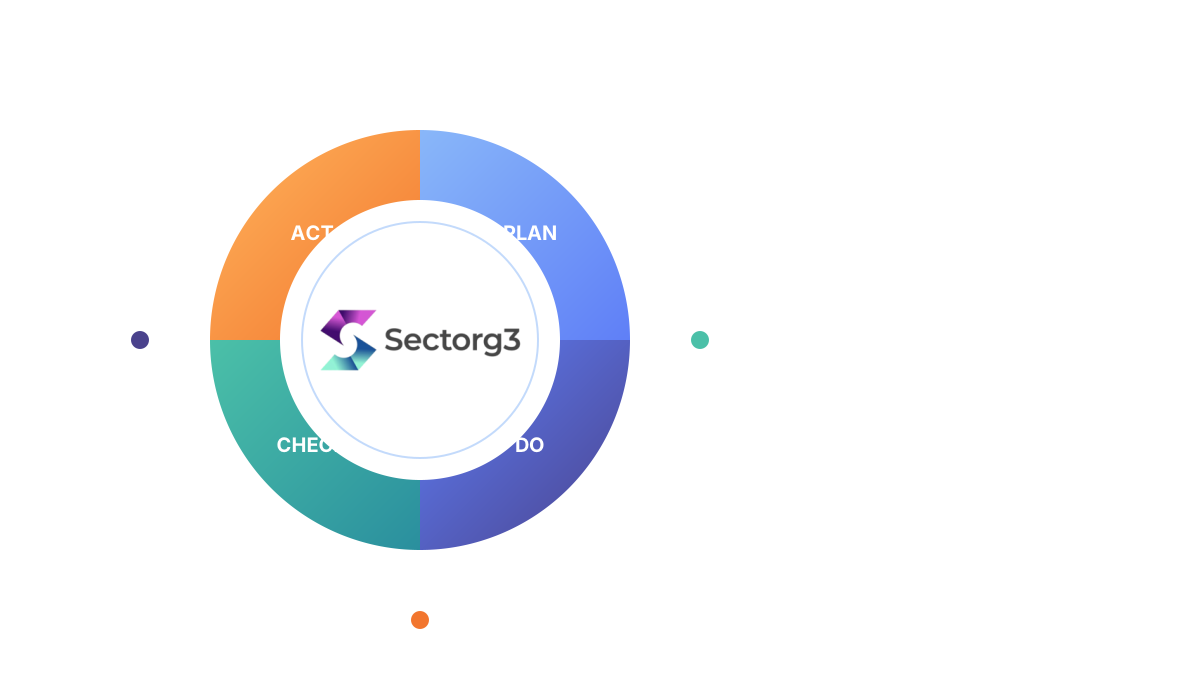
"Plan, Do, Check, Act" approach. We're an East African-based dedicated technology brand focusing on business, education, health & religions in more ways than one. It's a Modern and Complete Automation System that suites to almost every academy, health or religious institute(s) from employee/student/patient/member admission to employee/student/patient/member leaving, from fee collection to exam and final results. It includes 21+ modules for businesses, 30+ modules with 8 inbuilt users panel for academies, 34+ modules for health facilities and 25+ modules for religious institutes. Why Sectorg3 Stands Out
Sectorg3 is not a one-size-fits-all solution—it is a modern and complete automation ecosystem that adapts to the unique workflows of each institution. From the moment a student, patient, employee, or member is admitted, to the point of departure, every process is digitized, tracked, and optimized. This ensures transparency, efficiency, and reliability across all organizational levels.
By combining first-hand expertise with advanced automation, Sectorg3 delivers a system that is both scalable and future-ready, making it an indispensable tool for institutions seeking to modernize their operations while maintaining accountability and performance excellence.